
One of the things I’ve come to recognise over the years is that financial challenges in charities rarely arrive suddenly, rather they build quietly.
Often, by the time they are visible to everyone — at board level, in the accounts, or in the bank balance, they’ve been developing for months, sometimes years.
There’s an assumption that once a charity grows past a certain size, it should “graduate” from Excel. I don’t buy it. Partly because I’ve seen the other side of that trade: software that produces beautiful reports (dashboards, charts, graphs) that the finance team is proud of and the trustees or managers reading them don’t actually understand. A report can look impressive to the person who built it and still leave the person it’s for more lost than a plain spreadsheet would have. Fancy isn’t the same as useful.
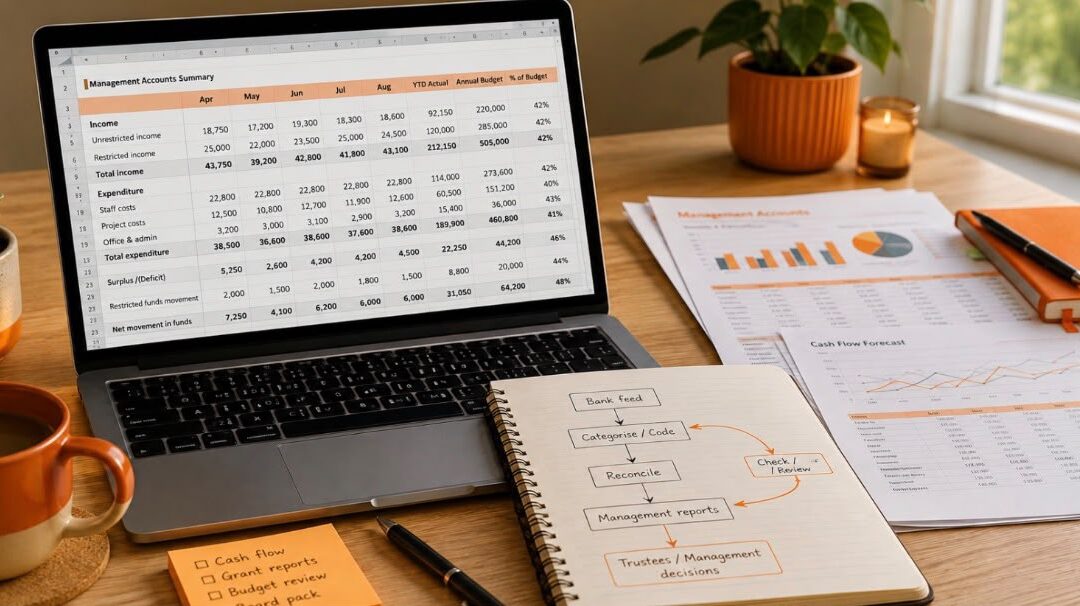
I still use Excel constantly; budgeting, forecasting, cash flow, grant monitoring, restricted fund tracking, scenario planning. The question isn’t “should we still be using Excel?” It’s “is Excel still doing what we need it to do?” Those are different questions, and mixing them up is how charities end up buying software they didn’t need.
Sometimes it really is enough
If you’re a small charity with straightforward finances and a handful of funding streams, you probably don’t need a finance system. If your spreadsheets tie back to your accounting records, someone checks them, and you’re not burning hours wrangling data to get an answer, there’s no problem here. And more software doesn’t automatically mean better financial management. Sometimes it just means another subscription.
The regulatory landscape is shifting, but not for everyone
Charitable companies and CICs are heading towards software-only filing at Companies House – from April 2028, accounts will need to be filed using commercial software rather than the paper or web routes. Charities that aren’t companies still file their annual return online with the Charity Commission, so this doesn’t touch them in the same way.
Itis worth separating two things, though: using software to file your accounts, and using software to run your entire finance function, are not the same decision. The regulatory change is a good reason to review what you’re doing. It isn’t, on its own, a reason to buy a new finance system.
So when does it stop being enough?
Usually you know before you do anything about it. The spreadsheet built for three projects now covers fifteen. The report that took two hours now takes two days. Figures get copied from one file into another and then into a third. Nobody’s sure which version is the final one. Or everything works fine, as long as the person who built it never leaves.
That’s what I’d watch for. Not whether you’re using Excel, but how much work Excel is generating around itself.
The one-person test
If whoever manages your key spreadsheets was off sick tomorrow, could someone else pick them up? Would they know which file to use, where the numbers come from, what needs updating, which formulas actually matter, and how to get the next report out the door?
If not, that’s a real risk. but I’d still hesitate to call it an Excel problem. It’s a resilience problem. Move the same undocumented process into new software and you’ve just built a shinier version of the same risk.
The software sandwich
I see this a lot: a charity already has finance software, but the actual process runs:
software → export to Excel → manipulate → copy → report → adjust → back into the software.
Nothing wrong with exporting to Excel for analysis or forecasting – I do the same. The question is what happens after. If you’re repeating the same manual steps every month and one person carries all of them in their head, ask yourself: is the problem the software, how it’s set up, or the process built around it? The answer isn’t always “get new software.”
Look at the process before the system
Before shopping for anything new, work out what you actually need. What do managers need to see? What do trustees need? Can you tell how your restricted funds are doing, produce a decent cash flow forecast, or see which projects are over- or under-spending? How long do management accounts take to produce, and where is the same work getting done twice?
… And check you’re actually using what you’ve already got. It’s surprisingly common to go looking for a feature you already own; project reporting, approval workflows, tracking categories, automated bank feeds, recurring transactions, reporting by fund or department. Sometimes the fix isn’t different software; it’s better use of what you’re already paying for: tidying the chart of accounts, setting reports up properly, or giving staff the training to use the system with confidence.
You’ll either find you don’t need to spend anything, or you’ll confirm you’ve genuinely outgrown your system. Both are useful outcomes.
When it might actually be time to change
There is a real point where new software makes sense: transaction volumes have grown significantly, you’re managing more restricted funds or contracts, reporting has got more complex, several teams need access, too much time goes on manual data-wrangling, your systems don’t talk to each other, or management information consistently takes too long to produce.
Those are far better reasons to migrate than “Excel feels old-fashioned.” And even then, start with “what problem are we solving?” — not “which software should we buy?”
Keep it proportionate
A £200,000 charity with three restricted funds doesn’t need the same finance stack as a £10 million charity juggling dozens of grants and contracts, and it shouldn’t feel behind for that. Your system should match your size, complexity and risk – which might mean accounting software plus Excel, an approval workflow bolted on, better use of your existing tools, or eventually a full migration. Good financial management isn’t measured by how many platforms you pay for.
So, is Excel enough?
Ask yourself: can you trust the numbers? Can you get them when you need them? Does more than one person understand how it all works? Are you getting full value from what you already pay for? And is the manual effort still reasonable?
If yes, Excel’s probably still fine. If the answers are trending no, something’s changed, but that’s a reason to look at your process, not to start browsing software websites.
Excel is enough when it supports the work. It’s time for something different when the work has quietly become about supporting Excel.
If you’re not sure whether the problem is the spreadsheet, the software, or the process wrapped around them, a finance systems and process review can help you work out what actually needs to change before you invest in anything new.
________________________________________
Hi, I’m Aishat, founder of BAnC Services.
With over 25 years’ experience in charity finance, I work alongside trustees and charity leaders to make sense of their numbers in plain English, so decisions are grounded in clarity rather than anxiety.
I specialise in governance-focused financial oversight, budgeting, and helping boards understand what their figures are really telling them.
Much of my work begins with conversations exactly like this.
If you’re looking for a jargon-free guide to charity finance terms, you might find Charity Finance from A to Z useful. The crossword book also offers an interactive way to become more familiar with the language used in charity finance.